7 min read
2025 Year in Review & the 2026 Year Ahead
Navigating Acceleration in an Age of Transformation A Bold Agendas Perspective by Mimi Brooks Executive Summary 2025 revealed no fewer than eight...

“Composability is the capacity to reconfigure the business as conditions change, without dismantling the foundation.”
Until 2024, Vodafone™ relied on large, monolithic systems – rigid, difficult to change, and costly to maintain. Then the company began grouping services into bundles and components by adopting what it called a composable mindset, driven by the need for faster innovation, smarter operations, and resilience at scale.1
While composable platforms have risen in popularity over the past decade, so too has the concept of composable business, an approach that breaks overarching business functions and disciplines down into their component parts. This allows for the same benefits as composable platforms, such as flexibility, and it also aligns business practices with the tech platforms that are built around them.
Salesforce™ advocated this kind of composable reasoning last year when it launched Career Connect®, an AI-powered internal talent marketplace. Once users create a profile, the platform infers skills based on their job history and helps employees create personalized career paths based on their skills and goals. The result saw the company fill half of roles internally by Q1 2025, with strong pilot engagement, showing a composable talent process rather than relying on rigid jobs.2
The ability to assemble and reassemble business capabilities, processes, and technology components quickly and flexibly—using these like building blocks to respond to change, create new value, and innovate without rebuilding the entire system—is rapidly emerging as a key technological and business advantage in this era of relentless disruption.
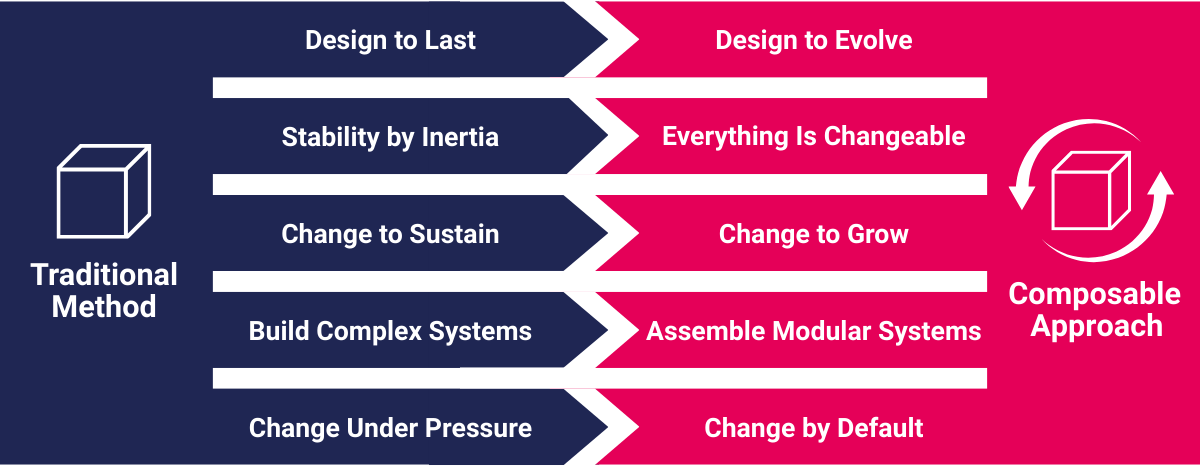
Traditional vs Composable Approaches
A composable business aligns business practices with the technology platforms that are built around them. It also allows organizations to evolve continuously rather than sporadically. Instead of launching massive, rigid transformations, leaders can adapt systemically and incrementally by assembling the right combination of capabilities as new conditions emerge.
From a technological perspective, composability means designing systems in modular, interoperable units so they can be swapped, scaled, or recombined on demand. Organizationally, it means structuring the enterprise so that teams, processes, and capabilities can be configured for different goals, thus enabling agility at scale.
The general concept of composability is akin to building blocks that form a greater whole. The form of that whole could begin as a house, then evolve into a tower. Composable architectures can change shape and add capabilities relatively easily, because they’re made of blocks of different shapes, sizes, and functionality that can be modified to fit a new need.

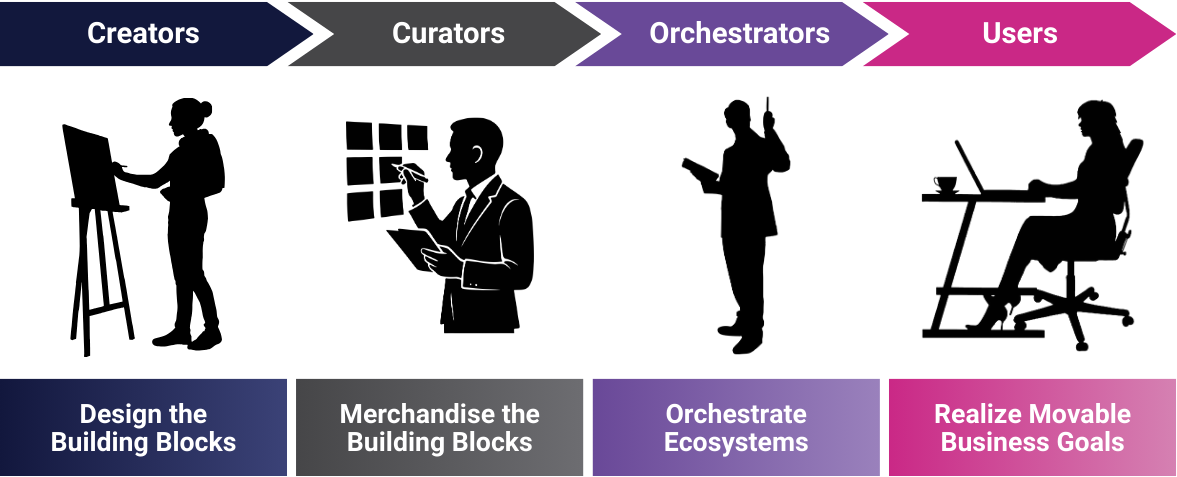
Composability in Action
As shown above, composable business is typically built on four main principles3:
These four principles guide the design and implementation of business components. This can refer to everything from the structure of teams and processes to the way new business opportunities are identified and acted upon.
Markets are moving faster, customer expectations are shifting more often, and technology cycles are compressing every year. Composability supersedes rare, disruptive transformation programs. Leaders can adjust incrementally and systemically, assembling the right mix of capabilities as new conditions appear while protecting the stability of the core.
The question for leaders is no longer simply "What is our strategy?", it is also "How composable is our business, and how quickly can we reconfigure it?"
1Altchek, Ana. How Salesforce is using AI career coaches to hire employees internally. Business Insider, May 2025.
2Sotiriou, Christos. Vodafone @ DTW 2025: Composable IT in Action. 2025.
3Natis et al. Becoming Composable: A Gartner Trend Insight Report. 2023.
7 min read
Navigating Acceleration in an Age of Transformation A Bold Agendas Perspective by Mimi Brooks Executive Summary 2025 revealed no fewer than eight...

8 min read
Sarah is a 28-year-old financial analyst at a global consulting firm in New York. Her office is modern, her role intellectually demanding, and her...
14 min read
Table of Contents 01. Introduction 02. Key Questions for Business Leaders What are the business implications of implementing Agentic AI? What new...